
Currently Empty: $0.00

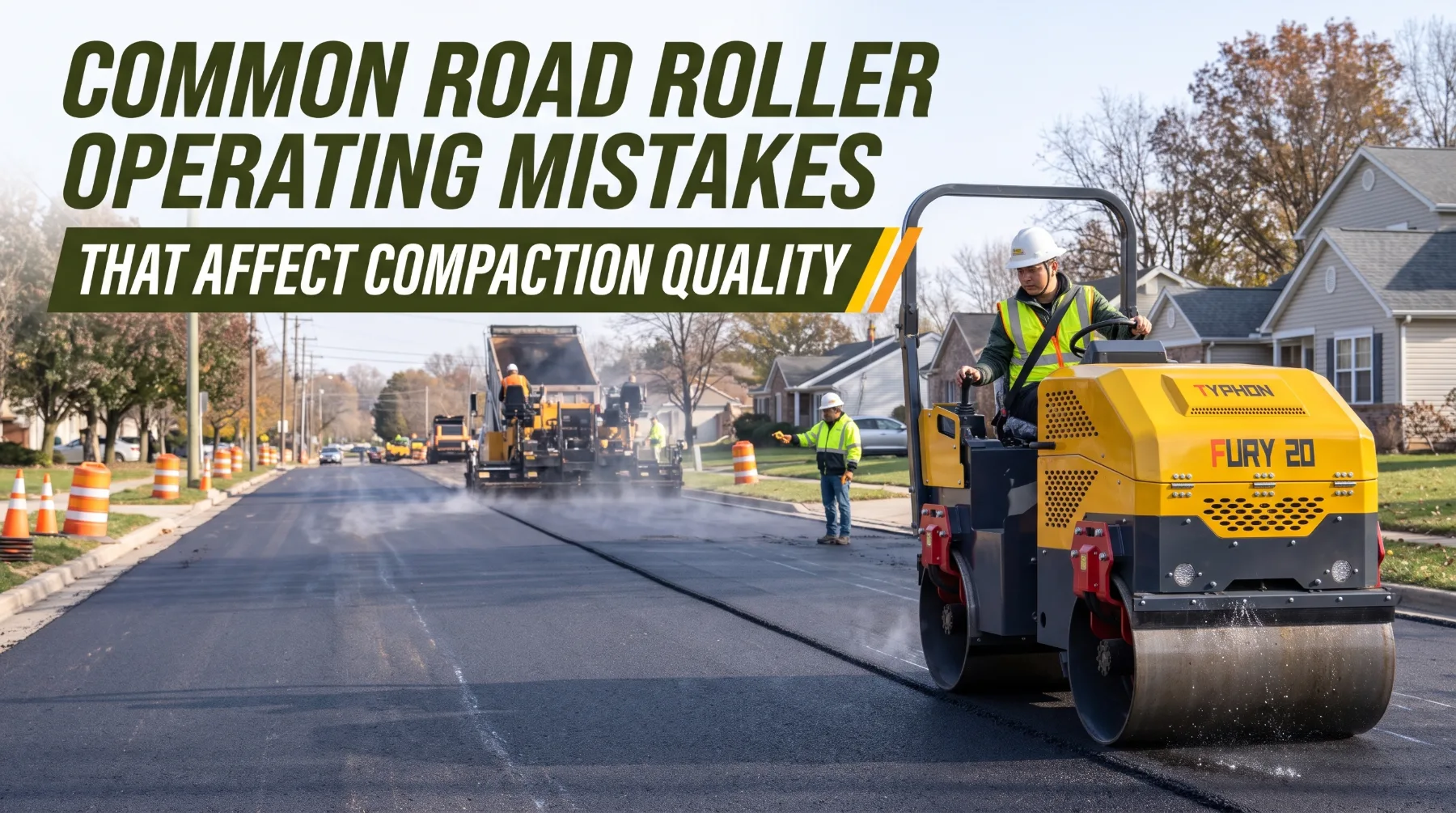
A paving crew places a smooth, even mat on a new subdivision road. The mix arrives at the right temperature, the paver runs steadily, and the screed leaves a clean finish. Two hours later, the quality-control technician reports that density is short in a strip along the centerline, with ripples near the end of the section. Nothing went wrong with the mix or the paver. Most of the problems came from the roller.
Road roller operation directly affects pavement density, surface uniformity, and long-term road performance. A mat that misses its density target lets water and air move through the pavement more easily. That can speed up aging, raveling, cracking, and moisture damage. Surface defects such as roller marks, shoving, and uneven texture may also require costly corrective work before the project can be accepted.
Most compaction problems trace back to a small set of avoidable operating mistakes. Incorrect speed, unsuitable vibration settings, poor rolling patterns, mistimed passes, abrupt movements, and weak coordination with the paving crew all reduce compaction quality. When operators recognize these mistakes and correct them early, they produce more consistent results and keep the paving train moving safely.
Rolling at the Wrong Speed
Speed is one of the simplest settings an operator controls, and one of the most commonly misjudged. It determines how much compaction effort each section of the mat receives and how well the roller keeps pace with the rest of the paving operation.
Excessive speed reduces the time the drum spends on each part of the mat. On static rollers, less dwell time means less compaction per pass. On vibratory rollers, higher travel speed spreads the drum’s impacts farther apart along the mat, leaving compaction uneven and the surface prone to a washboard or rippled pattern. High speed also reduces control, making direction changes harsher, steering corrections less precise, and stopping more abrupt, raising the risk of surface damage and injury to nearby crew.
Rolling slower is not automatically better, either. An overly slow roller can fall behind the paver, leaving sections of the mat cooling before they receive full compaction. On some mixes, very slow vibratory rolling concentrates too much energy in one area, causing the drum to dig in or mark the surface. Slow operation can also crowd the area behind the paver and create traffic conflicts with haul trucks and other rollers.
The correct speed depends on the roller type, asphalt mix, layer thickness, vibration settings, and project requirements. Many projects establish target speeds during a test section, where the crew measures density at different speeds and pass counts. Once the approved rolling plan sets a speed, hold it consistently. Follow the speed in the compaction plan, maintain a steady pace rather than accelerating and slowing between passes, match roller speed to paver speed so coverage stays continuous, slow near joints, edges, structures, and crew on foot, and coordinate with the paving superintendent when production rates change.
Key takeaway: Excessive speed reduces compaction uniformity and control, while unnecessarily slow operation disrupts the paving workflow, so hold the steady speed set by the approved compaction plan and keep pace with the paver.
Neglecting Inspection and Coordination
Even a skilled operator can’t produce consistent compaction with a roller that isn’t working properly, or in a paving operation where crews aren’t communicating. Mechanical problems and poor coordination are some of the most overlooked causes of compaction defects. Build every shift around these five practices.
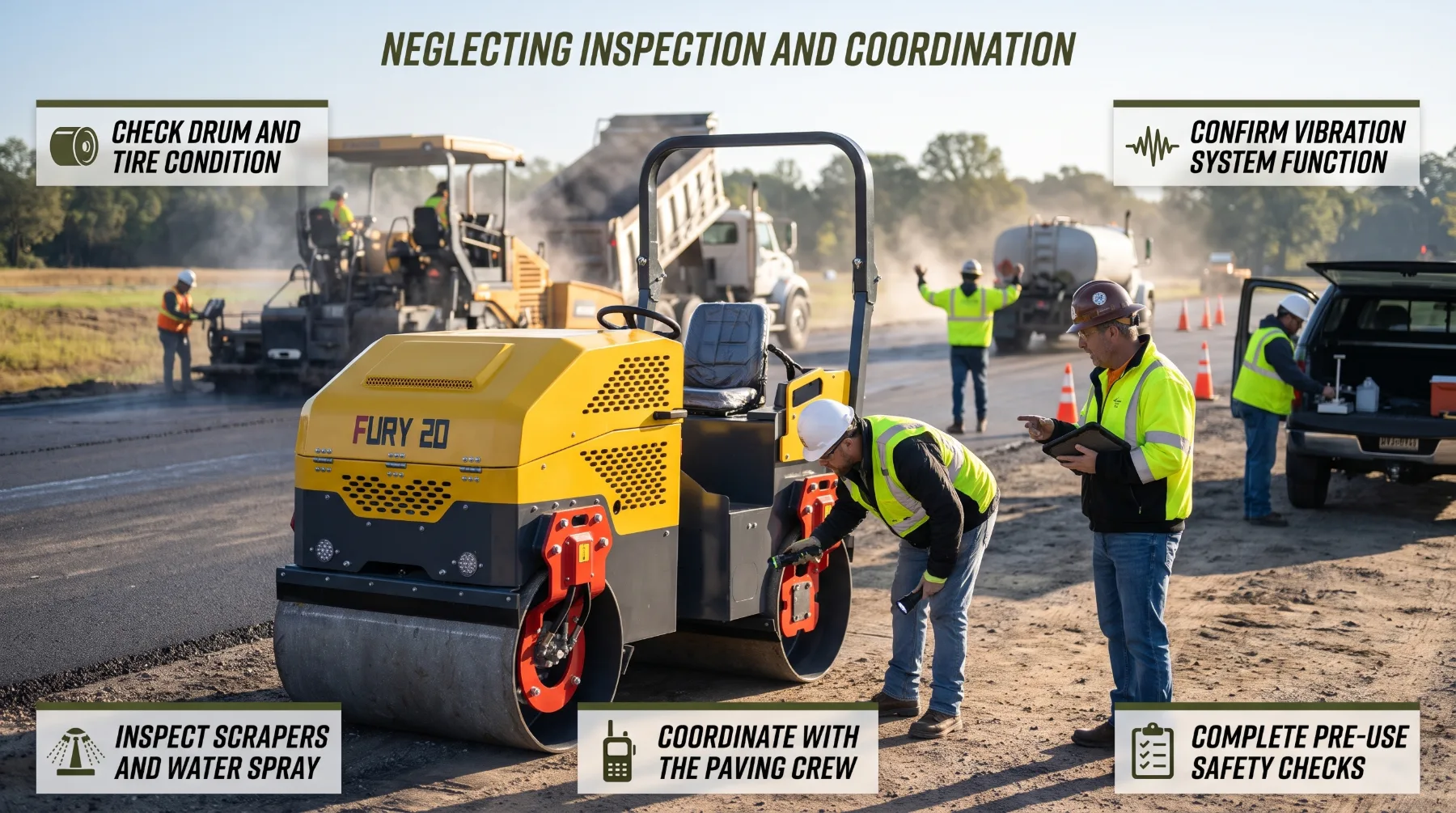
Drum and Tire Condition: Inspect drums for gouges, flat spots, and buildup, and check pneumatic tire condition and pressure where fitted.
Vibration System Function: Confirm vibration controls, mounts, and isolators work correctly, and report unusual noise, vibration, or performance changes.
Scrapers and Water Spray: Check scrapers, pads, spray nozzles, and water tank levels so asphalt doesn’t stick to drums or tires and tear the mat.
Pre-Use Safety Checks: Test brakes, steering, travel controls, backup alarms, lights, and cameras or mirrors where fitted before work begins.
Paving Crew Coordination: Agree on signals, traffic routes, roller zones, and communication with the paver, haul trucks, and quality-control team.
Worn or damaged drums leave marks and uneven contact. A malfunctioning vibration system may deliver less energy than its settings suggest, leaving the mat short of density without obvious warning. Damaged scrapers and clogged spray nozzles allow the mix to build up on drums or tires, where it can pick up material and tear the surface. Hydraulic leaks can contaminate fresh asphalt and create soft spots. Follow the manufacturer’s maintenance schedule for filters, fluids, lubrication, and vibration system service, and use only approved release agents. If a roller shows a fault during production, report it immediately. A roller that breaks down mid-shift leaves the mat cooling with no way to finish compaction.
Coordination protects quality and people. The paver speed, plant production, truck delivery, and roller spacing all affect results. When the paver speeds up without warning, rollers fall behind. When trucks arrive irregularly, the paver may stop and create cold spots. Regular communication among the paver operator, screed crew, roller operators, and quality-control personnel keeps everyone working to the same plan. Coordination is also essential for safety. Keep workers on foot away from pinch points and reversing paths, use spotters where required, respect edge and slope limits, follow the project’s traffic control plan, and always wear the seat belt where the roller is equipped with rollover protection.
Key takeaway: Inspect drums, tires, vibration systems, scrapers, water spray, and safety controls before every shift, report faults immediately, and coordinate closely with the paver, haul trucks, and quality-control team to protect both compaction quality and crew safety.
Missing Areas Between Passes
A roller can make the correct number of passes across most of the mat and still leave narrow strips that never reach density. These gaps are hard to see on a fresh surface but often show up in density testing and later as early pavement failures.
Poor overlap is the most common cause. When each pass doesn’t overlap the previous one by the required amount, a thin band of asphalt between drum widths receives less compaction. Inconsistent pass counts create the same problem across wider areas, where one part of the lane may receive five passes while another receives only three. Edges and joints are especially vulnerable. Longitudinal joints, where new material meets an existing lane or a cooler adjacent pass, are a common weak point in asphalt pavements. Unconfined edges can shove outward if the drum rides too far over them, which reduces density right where the pavement needs support.
A planned rolling pattern ensures every part of the mat receives equal compaction effort. Effective patterns define the rolling sequence for breakdown, intermediate, and finish passes, the number of passes for each roller, the required overlap between passes, the method for rolling longitudinal and transverse joints, and how to handle edges, crowns, and superelevated sections. Many compaction plans call for rolling from the low side toward the high side on crowned or sloped sections to limit shoving. Counting passes accurately on a long, uniform mat is harder than it sounds, so use consistent reference points such as edge lines, stakes, or paver position to track coverage. When more than one roller works behind the paver, each operator should know which section and phase of compaction they are responsible for, since overlapping responsibilities waste passes while unclear ones leave gaps.
Key takeaway: Poor overlap and inconsistent coverage leave under-compacted strips, so follow a planned rolling pattern with the required passes and overlap, give joints and edges special attention, and coordinate clearly with other roller operators.
Using Unsuitable Vibration Settings
Vibration helps aggregate particles move into a denser arrangement, which allows vibratory rollers to reach density in fewer passes. That benefit depends on using the right settings for the material, the lift, and the equipment. The wrong settings can waste passes, damage the mat, or crush aggregate.

Two settings shape vibratory compaction. Amplitude describes how far the drum moves during each vibration cycle, with higher amplitude delivering more energy into the mat. Frequency describes how many vibration cycles occur per minute, and together with travel speed, it determines how closely impacts are spaced along the mat. Many rollers let operators adjust amplitude, and some allow frequency adjustment as well. Each setting should match the conditions in front of the drum, not a habit carried over from the last job.
Common mistakes include using high amplitude on thin lifts, which can cause the drum to bounce, crack aggregate, or create surface checking; applying the same setting on every mix regardless of thickness, stiffness, or binder type; leaving vibration on while stopping or reversing, which can dent the mat; running vibration on bridge decks or near sensitive structures where the plan calls for static rolling; and using vibration during finish rolling when the plan specifies static passes.
Thicker base lifts can often absorb higher compaction energy, while thin surface courses usually need lower amplitude or static rolling. Stiff mixes, polymer-modified binders, and warm-mix asphalt may each respond differently. Follow the roller manufacturer’s guidance and the project’s compaction plan rather than relying on one standard setting. Watch the mat closely during vibratory rolling. Ripples, cracking, shoving, or drum bounce usually signal that settings, speed, or timing need adjustment. Report these signs to the paving superintendent right away so the crew can respond while the material is still workable.
Key takeaway: Amplitude and frequency must match the roller, the asphalt mix, and the lift thickness, so follow manufacturer guidance and the compaction plan, turn vibration off before stopping or reversing, and adjust when the mat shows signs of distress.
Ignoring Asphalt Temperature
Temperature controls how readily asphalt responds to compaction. A roller can deliver the right speed, settings, and coverage and still miss density if the mat is outside its suitable temperature range.
The suitable range depends on the mix design, binder grade, any warm-mix technology, and project specifications. How long the mat stays within that range depends on lift thickness, air temperature and wind, base or existing pavement temperature, and delays in truck delivery or paver stops. A thin lift placed on a cool, windy morning can lose its compaction window quickly, while a thick lift on a warm afternoon may stay workable much longer.
Key takeaway: Asphalt must be compacted within the suitable temperature range for the mix and project, so monitor mat temperature continuously, plan rolling around how quickly the window closes, and coordinate adjustments with paving and quality-control personnel.
Making Abrupt Turns or Stops
Fresh asphalt remains workable for a reason: it needs to move under the roller to densify. That same workability makes it vulnerable to sudden steering, braking, and stopping. Abrupt movements can leave defects that are difficult or impossible to remove once the mat cools.
Common defects caused by abrupt operation include drum depressions from stopping or parking on the hot mat, transverse ridges where several rollers stop and reverse at the same line, shoving and tearing from sharp steering on workable material, scuff marks from sudden acceleration or braking, and edge displacement from turning too close to unconfined edges. These defects affect both ride quality and appearance and may require corrective work before the project is accepted.
Smooth operation protects the surface and supports consistent compaction. Operators should change direction gradually with smooth deceleration and acceleration, turn vibration off before stopping or reversing and re-engage it only once the roller is moving, stagger stopping and reversing points so they do not line up across the mat, avoid parking or idling on hot asphalt, make steering corrections gently on fresh lifts, and follow the prescribed turning and stopping procedures in the compaction plan. Edges, joints, tapers, and transitions need extra care. Keep drums back from soft or unconfined edges as the plan directs, and use deliberate movements during finish rolling. Abrupt movements also create safety risks, since rollers spend much of their time reversing and sudden changes give nearby workers less time to react.
Key takeaway: Sudden steering, braking, or stopping can mark or distort workable asphalt, so change direction smoothly, turn vibration off before reversing, stagger stopping points, never park on the hot mat, and take extra care at edges and joints.
Conclusion
Asphalt compaction quality depends on consistent operating decisions throughout the paving process. Maintaining a steady roller speed matched to the paver helps produce uniform compaction, while vibration settings suited to the roller, asphalt mix, and lift thickness help achieve the required density without damaging the surface. Following a consistent rolling pattern with proper overlap prevents under-compacted strips, particularly around joints and pavement edges. Operators must also work within the mix’s specified temperature range because asphalt becomes harder to compact as it cools. Smooth turns, controlled stops, and careful changes in direction help prevent surface marks and distortion. Regular equipment inspections and close coordination with the paving crew support reliable performance and safer work zones. Review the approved compaction plan with the paving superintendent and quality-control team, confirming target speeds, vibration settings, pass counts, and overlap requirements. Inspect the roller’s drums, tires, vibration system, water spray system, controls, brakes, and safety devices before operation. Agree on communication signals and traffic routes with the crew, and coordinate rolling operations with the paver to maintain a consistent paving rhythm. Keep asphalt temperature and density checks on schedule, adjusting the rolling process according to project specifications and field conditions. Consistent speed, correct vibration, proper overlap, and timely quality checks help achieve the required density, smoothness, and long-term pavement performance.
Frequently Asked Questions
Can excessive roller speed reduce compaction quality?
Yes. Excessive speed reduces the compaction effort applied to each part of the mat and spreads vibratory impacts farther apart. That can leave density uneven and create a rippled surface. Follow the speed set in the approved compaction plan and keep pace with the paver.
Should vibration always be used on asphalt?
No. Vibration settings and their use depend on the roller, asphalt mix, lift thickness, and project plan. Thin lifts, bridge decks, areas near sensitive structures, and finish rolling often call for static passes. Always turn the vibration off before stopping or reversing.
Why is asphalt temperature important?
Temperature affects how readily asphalt compacts and whether the required density can be achieved. When the mat cools below the suitable range, the binder stiffens and additional passes add little density. Thin lifts and cool, windy conditions shorten the time available for effective rolling.
How can operators prevent uneven compaction?
Use a consistent rolling pattern, maintain the required overlap, and give joints and edges special attention. Monitor temperature, hold a steady speed, use suitable vibration settings, and follow the project’s compaction requirements. Regular density testing confirms whether adjustments are needed.
Featured Machinery & Equipment
mobilecranes.org Featured Equipment
Looking for top-performing heavy equipment, authentic attachments, and dependable jobsite power? Explore verified models backed by manufacturer warranty and nationwide delivery.
